
I’ll never forget the day when my friends Tim and Justin traipsed into my college apartment in high spirits, telling me they were questioning the idea of eternal conscious torment – in other words, the apparently Christian belief in ‘Hell’. What they received in response was a full-throated and passionate defence of the undying flames of judgment courtesy of my strict Calvinist upbringing.
So a few weeks back, when Kirk Cameron tentatively prodded at that same notion of Hell and eternal torment, I wasn’t surprised when an angry mob of apologists, evangelists, YouTubers, ‘TheoBros’, and even staunch conservative PhDs (like Southern Baptist Theological Seminary president Al Mohler) quickly lit the torches and came for his head.
Honestly, though, I was surprised at the naiveté of someone as ‘Christian famous’ as Cameron. Surely he’s spent more than enough time in the evangelical trenches to realise what he was wading into. He should have known that nothing makes conservative evangelicals angrier than suggesting that God might not intend to slow roast all but a tiny percentage of humans for endless eons, until the meat becomes tender and the skin takes on a chargrilled, glossy sheen. So what did Cameron do when confronted with the enraged throng of critics? He beat a hasty retreat back to the safety of a theology in which potential damnation stays on the table.
Yet why was the backlash both my friends and Kirk Cameron received so severe in its intensity? Why are so many conservative evangelicals so committed to the belief that something like, oh, I don’t know, scratching up the side of your parents’ Ford Tempo when reversing from the garage and telling them it was the fault of a careless driver in the Shoprite parking lot is a crime deserving of everlasting pain and suffering?
I mean, sure, some of it is probably schadenfreude: relishing the image of your personal or ideological adversaries crying out in agony, “Adam was right all along!” as they complete a rotation on the spit every thousand years or so. But I suspect that questioning Hell is challenging something much deeper.
And that something is biblical inerrancy.
No Margin for Error
In the 18th and 19th centuries, when scientific, archaeological, and literary discoveries chipped away at the historical veracity of biblical texts, Christians had a choice to make. Some decided they needed to open themselves to a different understanding. They chose to learn new ways to view and interpret these texts.
Then, there were the fundamentalists. In fact, modern Christian fundamentalism was born at this time. Would these fundamentalists explore new ways to read and think about scripture? Of course not. They did what fundamentalists do best: they doubled down, rather than admit they might be wrong about anything. They decided the hills of 6000-year-old universes, and long-lost gardens with talking snakes, and global floods with floating menageries, and genocidal deities were worth dying on to preserve the ‘integrity of scripture’. Or they were scared to navigate life with a less-than-straightforward collection of ancient texts. Either way, the result was the same.
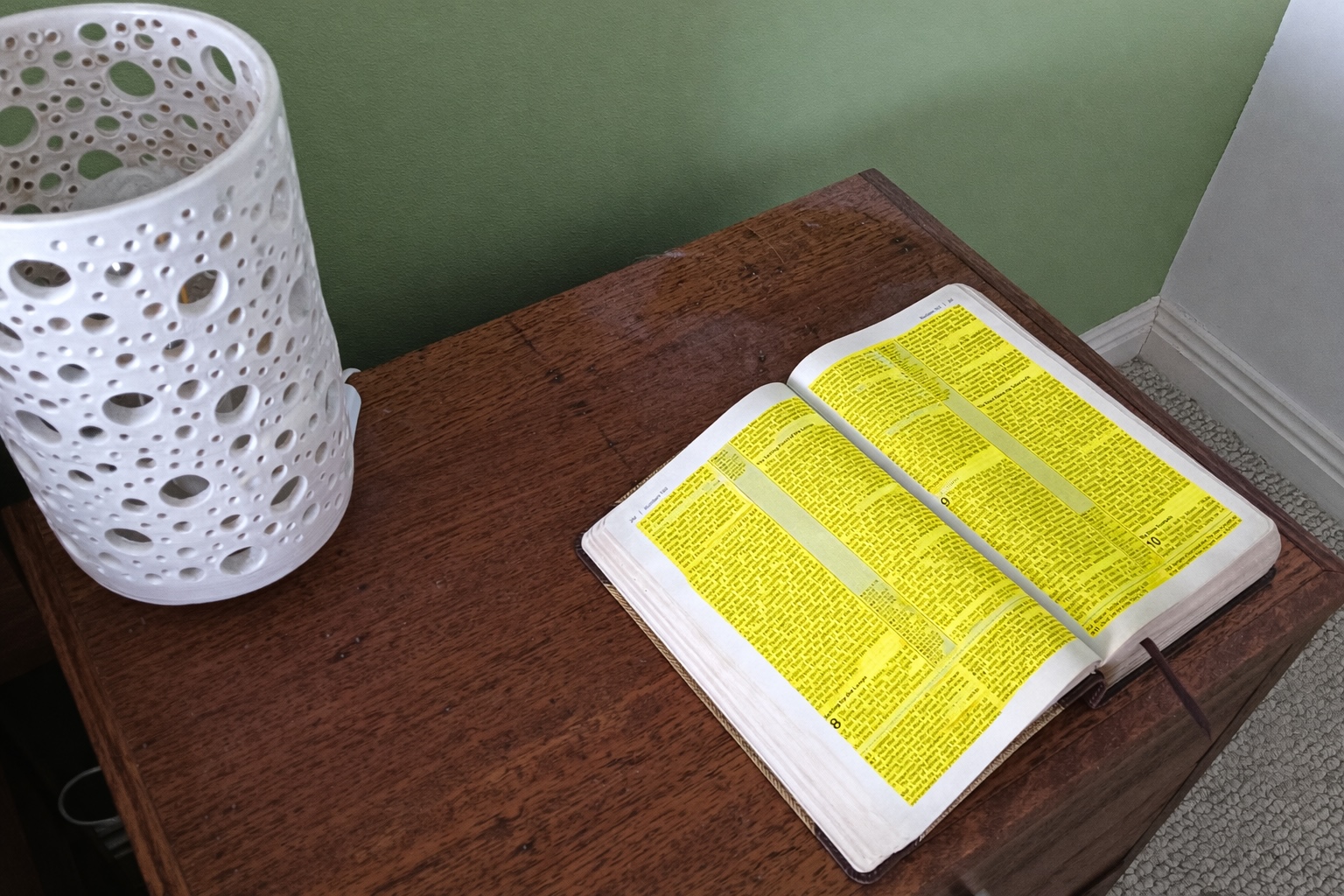
Thus was born the idea of ‘biblical inerrancy’, the framing of scripture as the “infallible divine authority in all matters upon which it touches”1. In other words, when science or archaeology dispute aspects of the biblical text, it’s science and archaeology that are wrong. Scripture’s pronouncements, whether on theology, biology, geology, sexuality, or history, are absolute. No statement can be questioned, and no contradictions exist.
Contemporary evangelicalism arose as a ‘gentler, friendlier’ offshoot of fundamentalism. While it may have softened some of the hard edges, it hung on to the concept of inerrancy, elucidated and codified it into a formal doctrine 2
The root of the (American) Evangelical Tree
At this point, you might be asking, “Why does any of this matter?”
First, consider that, much like the concepts of ‘the Rapture’ and ‘the Tribulation’, inerrancy is far more accepted and far more popular in the United States than anywhere else3. Then, think about the issues American Christians are angry about. It shouldn’t take long for us to see that this anger has its roots – and its justification – in a ‘straightforward reading’ of an ‘inerrant’ Bible.
How many times have you heard an American evangelical pastor or pundit state that “the Bible is clear about ________”? Of course, the subtext is, “In my iron-clad interpretation of scripture, I can cite a verse that champions or prohibits _____________, without acknowledging or considering potentially culturally relevant or contradictory ideas found within or outside of that particular passage.” But that’s a mouthful; it’s much easier to have a ‘God said it, I believe it’ attitude toward sacred texts.
It certainly makes it simpler to authoritatively comment on these hot-button issues with the appropriate degree of righteous indignation:
Do you want to prove America is, and should be, a ‘Christian nation’ and should have ‘biblical’ laws? There are verses for that! Try Psalm 33:12, for example: “Blessed is the nation whose God is the LORD; and the people whom He hath chosen for His own inheritance.” Or maybe 2 Chronicles 7:14: “If my people, which are called by my name, shall humble themselves, and pray, and seek my face, and turn from their wicked ways; then will I hear from heaven, and will forgive their sin, and will heal their land.”4
Do you want to prove abortion should be stringently proscribed? There are verses for that, like the always-popular Psalm 139:13: “For you created my inmost being;
you knit me together in my mother’s womb.”5
Do you want to prove that homosexuality is an abomination? Hey, there are verses for that! In fact, Leviticus 18:22 is right up your alley: “Thou shalt not lie with mankind, as with womankind: it is abomination.” And don’t get me started on Romans 1.
Do you want to defend the sanctity of your birth-assigned bathroom and prove that gender and trans issues are a farce? There are verses for that! How about tried-and-true Genesis 1:27?: “So God created man in His own image, in the image of God created He him; male and female created He them.”
Do you want to crush the ‘feminist agenda’ and keep women away from leadership and away from the pulpit? There are verses for that! You might go with 1 Timothy 2:12: “But I suffer not a woman to teach, nor to usurp authority over the man, but to be in silence.”
It doesn’t stop there. When you hold fast to inerrancy, and want to view science and scientists with contempt, you can easily call the early chapters of Genesis to your aid. If you want to associate present events with the coming end of the world, you can recruit verses for that. If you want to write the current government of Israel a blank check to do as they will to the Palestinian people, you can call up verses for that. If you want to suggest that historical slavery was actually beneficial to black people, you can use the same verses that slave owners used to justify slavery in the first place.
And if you wanted to do battle with Kirk Cameron and his ilk and prove the reality of eternal conscious torment, there are enough references to fiery lakes and endless burning for you to enlist.
Game, set, and match.
And It doesn’t matter that these verses are pulled from the context of their time period, genre, language, and culture. In fact, for the average biblical inerrantist, ‘context’ is a dirty word. He has these cut-and-dry verses, and others like them, that substantiate what he believes. No, it’s more than that: these cut-and-dry verses tell him what he must believe.
Problems abound, though, with this ‘cut-and-dry’ way of reading scripture. That will be the subject of Part 2.
- Chicago Statement on Biblical Inerrancy, 1978
- In fact, they held their own conference on inerrancy in Chicago in 1978, producing a well known statement with 19 (!) articles.
- It was largely the work of Princeton Seminary theologians like A.A. Hodge and B.B. Warfield that built the case for biblical inerrancy
- I’ve used the King James version for most of these verses, because so many hard-core inerrantists have historically loved the dulcet prosody of a King James quote.
- I didn’t use the King James on this one – and I think you’ll hear very few people quote that version here – because its text, “For thou hast possessed my reins: thou hast covered me in my mother’s womb”, doesn’t give the same ‘clear-cut’ emotional hit as the NIV.
image sources
- The ‘Inerrant’ Bible: Photograph by Author
Adam Lee Benner

A teacher and writer born and raised in New Jersey’s Philadelphia suburbs, Adam writes about his former life in American Christian nationalism and the Evangelical right – and (hopefully) better ways to be Christian. He lived for several years with his wife and best friend, Renée, as missionaries in Asia before relocating to her hometown of Melbourne, Australia with their two sons.
Leave a Reply