
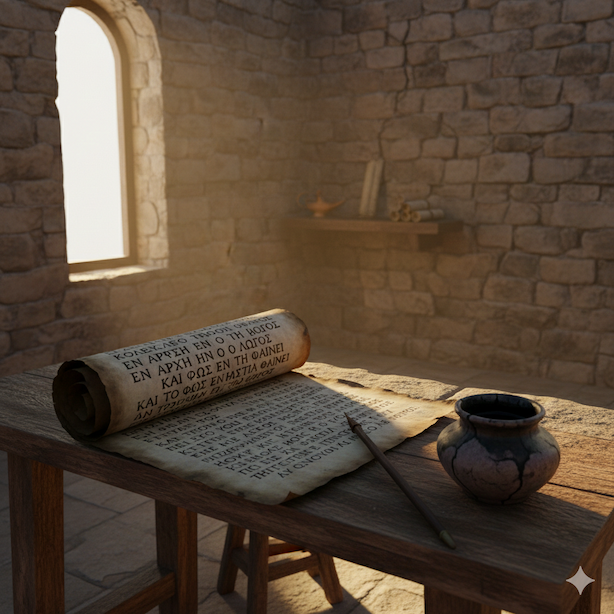
We used to pledge allegiance to the Bible every morning at my Christian primary school. Right after we pledged allegiance to the American flag and then the Christian flag, in that order. It’s important to keep your priorities straight.
Following that pledge, we’d sing a song:
"The B-I-B-L-E, yes that's the book for me!
I stand alone on the Word of God, the B-I-B-L-E."
Some of us would even belt out the lyrics while standing on our own Bibles. At least until our teacher warned us against treating the holy book with disrespect, and presumably allowing trace elements of grit and dirt from the playground to damage the bonded leather covers and to soil the pages of sacred writ.
But what happens when the book we’re standing on starts to feel unstable? What happens when weak points appear in the ways we were instructed to read biblical texts? What happens when the so-called ‘doctrine’ of inerrancy we were taught begins to reveal its flaws? What now? What do we do with the Bible?
For you, it may feel like you’ve worked a job for thirty years, the same job your father and grandfather worked. Then, along comes a storied European firm that buys out your company and starts to impose its pretentious ‘Eurotrash’ ways. You resist. We’ve done things our way for generations, and as far as we can see, it has worked just fine. Maybe you have the same reaction to the Bible: we’ve read it this way for generations; why change that?
Or maybe you want to make changes – but you’re afraid the boss won’t let you. In the case of the Bible, ‘the boss’ might be your pastor, or your community, or one of your influences, or even God himself. Maybe you’re also afraid that reading the Bible differently might result in rethinking things like science, history, nationalism, LGBTQ+ issues, and a range of theological matters and you don’t feel ready for that.
Still others might think of the Bible as a temperamental appliance. You sweat and clench your sphincter every time you go near it, wondering if it will give you a painful shock. Will it ever feel safe to touch? Or maybe others have weaponised it like a stun gun against you, admonishing you to rethink your life while you quake and splutter on the floor, drooling.
I did just that once upon a time. Espousing strict inerrancy, I believed every word in the Bible was in perfect agreement with every other word. I believed that God had essentially crafted the entire text just for us. I believed evolutionary scientists were all deluded. I believed the Bible could predict the future with perfect accuracy, and had predicted historic events, like the rise of the modern state of Israel. I believed that LGBTQ+ people were evil and rebellious. I believed all this, because it was apparently all there in black and white. So I used the Bible as a weapon to win arguments and be ‘right’.
But there are better ways to read the Bible than my immature and ignorant approach. There’s love, wisdom, goodness, and truth to be found within its pages, if our goal is to find them. In that spirit, here’s a few questions I think can help us to approach the texts of the Bible in a new and ultimately more fulfilling way:
“Am I allowing this author to write from within his or her1 culture?”
Inerrancy is like an angry toddler who wants to stay up past its bedtime and watch TV. It makes stubborn demands until it gets what it wants. It demands a Bible written directly to us, one in which each author writes the kind of precise journalism of history and science our society says it values. It demands clear dictates and lists of error-free propositional statements about God, about humanity, about what to believe about what and about whom.
But the simple truth is that the Bible wasn’t written to you or to me. It wasn’t written for you or for me. Its books were written instead to ancient audiences, in ancient non-western cultures, speaking ancient languages. And ancient writers cared far less about detailed and empirical accuracy than post-Enlightenment moderns do.
So often, we want the biblical authors to supply facts about and rules for our world, but whenever we read these texts, we’re invading theirs. We’re the outsiders. The writers of scripture don’t need to adjust to our way of thinking and viewing the world. We need to attune our own perspectives, as much as possible, to their historical, cultural framework.
Whenever we speak or write, we leave out a lot of implied information. We expect readers and listeners to fill in that information using our shared understanding of language and culture. As an example, think of a meme you’ve recently seen. Usually, it’s a image with a small number of words. Why does it work? Because you share an understanding of events, word play, idiom, humour, and cultural norms with the meme’s creator.
The biblical authors did the same. They left out cultural information they naturally expected their audiences to understand. But this is where we create problems: we fill in the authors’ implicit gaps with our own cultural information and expectations.
Here’s an example. When modern, western readers encounter the story of Jesus and the woman at the well in Samaria (Jn. 5), we commonly label the woman as sexually promiscuous or adulterous. That’s drawing from our own cultural perceptions of (usually famous) people on their fourth or fifth marriage. We forget, though, that women in ancient Palestine were essentially family property; they had no say or control over when or who they married. Knowing that should change the way we interpret this story.
And that’s the corrective – to study, as much as possible, how the original ancient audience would have filled in the implicit information.
“What’s the genre of this book or passage?”
Take a walk into a large bookstore. On one of the racks, you’ll probably find some nonfiction texts on church history, if you’re into that subject, or you just need something to put you to sleep at night. You might see collections of poems by well known figures from church history on another rack. And for some reason, Dan Brown has been emboldened to churn out clumsy works of fiction based on his own and others’ fanciful hot takes on church history. You’ll probably find those books somewhere near the front. Thousands upon thousands of authors, writing about hundreds of thousands of topics, in a diverse range of genres.
The biblical writers were no different. Why would we expect them to be? Why do we limit the genres they’re allowed to use? Why do we forbid them from using the creativity, metaphor, hyperbole, symbolism, and artistic license we’re happy to permit in any other author?
If we come to the books of scripture asking ourselves, “What kind of text am I reading?” and “In what genre is this author writing?”, we can avoid the trap of reading the Bible as a 1200-page factsheet on cosmology, biology, world history, and the afterlife.
“What kind of truth is the author trying to communicate?”
Both ardent defenders and hardened detractors of the Bible fixate on whether its stories are ‘right’ or ‘wrong’. But ‘right or wrong’ is the wrong way to look at it. Since the Bible’s texts are situated within their time, cultures, and genres, the important question is, “What was each author trying to communicate?” Truth and wisdom can be found through story and through poetry, not just through an encyclopaedia of theological precepts.
The writers of Genesis, for instance, refer to the ‘pillars of the earth’ (foundational columns holding up the ground), the ‘firmament’ (the sky as a solid dome surrounding the world), and the ‘floodgates of heaven’ (sluice gates in the firmament through which rain falls). That jives well with ancient Near Eastern cosmology, not so well with our contemporary understanding of earth and space science.
But that’s not what matters to the authors, so it shouldn’t matter much to us. Again, they’re simply working in the conceptual understanding of the world they share with their audience. Far more vital is what does matter to the writers. What is it about God and about the world they want their audience to understand?
“What can I learn from knowledgable others?”
A large sector of evangelicalism has long fostered a distrust of academic learning. Growing up, I heard things like, “Listen to God’s truth, not man’s truth!” and “God laughs at man’s wisdom!” Thus, pastors and members of evangelical churches will often scoff at reading all but a narrow list of approved biblical commentators – approved because they already agree with everything those congregations think about the Bible anyway. We don’t need any input from so-called scholars, these leaders and congregants will say.
Now that’s the kind of ‘wisdom’ I expect God does laugh at, because it’s stupid. If we’re approaching a set of texts from ancient cultures and archaic genres, and written in ancient languages, then it seems like good sense to learn from a broad range of smart people who have studied those cultures and genres and languages. And there are plenty of accessible books written to help us with these things. Here are just a few I’ve found helpful:
- A Survey of the Old Testament (Hill and Walton)
- The Lost World Series (John Walton)
- The New Testament in Antiquity (Burge and Green)
- The New Testament for Everyone Series (commentaries by N.T. Wright)
- The Cultural Backgrounds Study Bible (Walton and Keener)
Plenty of others could fill out that list. So next time you’re at the Christian bookstore, maybe bypass the megachurch pastor’s latest treatise on living your best life by following 10 biblical principles, and grab something more educational.
Just one more thing…
I’ve found these questions a great start to engaging with the Bible without the dead weight of inerrancy. There’s another question still to address – so crucial it demands its own treatment. That will be the subject of Part 4.
- It seems relatively certain, given education levels and common practices, that most if not all of the biblical writers were men. We shouldn’t completely rule out, though, the possibility of female authorship of some texts.
image sources
- Scroll in Ancient Room: Image created by Gemini at author’s request
Adam Lee Benner

A teacher and writer born and raised in New Jersey’s Philadelphia suburbs, Adam writes about his former life in American Christian nationalism and the Evangelical right – and (hopefully) better ways to be Christian. He lived for several years with his wife and best friend, Renée, as missionaries in Asia before relocating to her hometown of Melbourne, Australia with their two sons.


Leave a Reply