
A Great Plan
Back in 1998, Bruce Willis was still at the height of his powers. Ben Affleck was fresh off the success of Good Will Hunting. Liv Tyler was the new ‘it’ girl. Owen Wilson was a young up-and-comer. And people still found Steve Buscemi funny. Hollywood knew it was time to strike while the iron was hot and the result was the cinematic masterpiece, Armageddon.
The movie begins with a gargantuan asteroid hurtling toward our planet, threatening to wipe out all life. NASA eventually decides to put a deep-water drill team through a crash course in extraterrestrial aeronautics – during which the fish-out-of-water hilarity ensues – then send them into space to intercept and pulverise the asteroid with nuclear explosives. A brilliant plan! I mean, that’s what I would do.
Well, this is Hollywood, so naturally, the plan goes awry when one of the drilling machines gets hopelessly stuck. Only after Bruce Willis chooses to sacrifice himself and remain behind to unjam the machine and set off the explosives is the asteroid destroyed and the day saved. No surprise there. Watching all those Die Hard movies (full disclosure: I stopped after the third one), we should have known he’d come through for us in the end.
Of course, the title Armageddon calls back to the storied ‘final battle’ found in the book of Revelation. What does that have to do with asteroids? Not a damn thing. It’s just a sexy title that’s meant to imply the end of the world.
A Place Called Megiddo
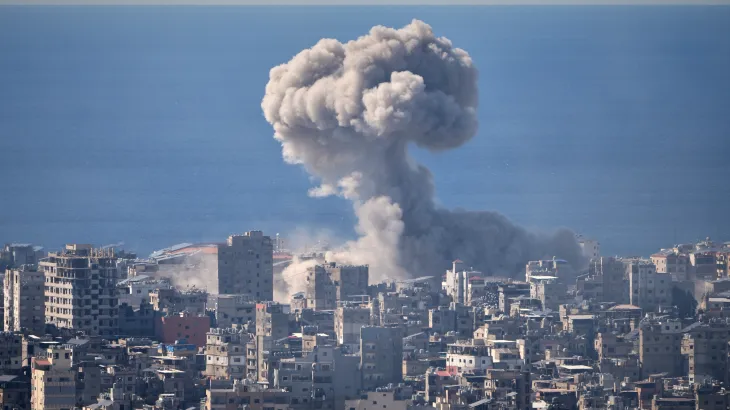
Fast forward 28 years (!) and we find ourselves embroiled in a war in the Middle East. Stop me if you’ve heard this one. Apparently, some have even gone so far as to suggest that this war would bring about the biblical Armageddon.
What does this conflict in Iran have to do with the Armageddon of Revelation? Again, not a damn thing. And those who claim that it could have a shallow understanding of the relevant texts.
The name ‘Armageddon’ derives from Megiddo, an important and elevated ancient population center overlooking the Jezreel Valley, with its high rainfall totals and fertile alluvial soil. Megiddo also stood at the juncture of several vital routes of trade and travel. We can picture a thriving settlement, surrounded by olive groves and vineyards, visited daily by caravans of animals, people, and goods.
When a Battle Isn’t a Battle
When you have all that stuff, though, everybody wants it. So it’s no surprise Megiddo became a significant battlefront in many conflicts. The ‘Song of Deborah’ in Judges 5, deemed one of the oldest biblical poems we possess, describes Megiddo as a place where kings come to battle – and God wins the victory.
Thus, it’s no surprise that John of Patmos (who makes more blatant allusions to Hebrew scripture than any other N.T. writer) draws on the imagery of Megiddo to describe the final ‘battle’ in his book, Revelation (19:11-19)1:
Then I saw heaven opened, and there was a white horse! Its rider is called Faithful and True, and in righteousness he judges and wages war… He is clothed in a robe dipped in blood, and his name is called The Word of God. And the armies of heaven, wearing fine linen, white and pure, were following him on white horses. From his mouth comes a sharp sword with which to strike down the nations… On his robe and on his thigh he has a name inscribed, “King of kings and Lord of lords.”
Then I saw the beast and the kings of the earth with their armies gathered to wage war against the rider on the horse and against his army. And the beast was captured, and with it the false prophet… These two were thrown alive into the lake of fire that burns with sulfur.
This is a ‘battle’ scene promised way back in chapter 16, to take place on the plain of Megiddo, and on the surface, it may look like a violent Middle Eastern war waged and won by Jesus himself. Yet what’s really going on here is far more interesting. What it actually shows us is Jesus, dressed in a robe dipped in blood – his own – and leading an army of Christian martyrs, also dressed in white. They carry no weapons; in fact, the only ‘weapon’ is the ‘sword’ which emerges from Jesus’ mouth, a powerful symbol of his word. The ‘beast’ and the ‘false prophet’ aren’t even killed. They’re captured alive and thrown into the fires of judgement.
What it Means to Conquer
“Wait!” you may ask. “How do we know all this is true?”
A fair question. We know because all this fits the context of the entire book of Revelation.
John of Patmos (who popular Christianity thinks was John the Apostle, but probably wasn’t) writes to an audience of 7 churches in what is now Türkiye, Christians whom he believes may soon face violent martyrdom. 2 Each of his letters to those churches (chapters 1-2) ends with a promise to ‘the one who conquers’. How does one ‘conquer’ in Revelation? Simply put, by remaining faithful to Jesus in the face of persecution and martyrdom – following his example, the example of the hero and key figure of the book, the slaughtered Lamb 3 This is stated explicitly and powerfully in chapter 12, when the dragon figure (the satan) is defeated and thrown from heaven.
Now have come the salvation and the power
    and the kingdom of our God
    and the authority of his Messiah,
for the accuser of our brothers and sisters has been thrown down,
    who accuses them day and night before our God.
But they have conquered him by the blood of the Lamb
    and by the word of their testimony,
for they did not cling to life even in the face of death.
Revelation 12:10-11
The martyrs appear again and again in Revelation, in the white robes that signify their victory.
That’s how we know it’s the martyrs Jesus is leading in the Armageddon scene (from their white robes), that Jesus’ robe is dipped in his own blood (the ‘battle’ hasn’t even happened yet, so who else’s blood would it be?), and that the only ‘weapon’ is Jesus word – because those are the ‘weapons’ that conquer: the blood of the Lamb and the word of testimony.
Not What We Expect
“But wait!” I can hear some saying, “The last verse of the passage tells us that ‘the kings of the earth and their armies… were killed by the sword of the rider on the horse, the sword that came from his mouth, and all the birds were gorged with their flesh’. That’s a violent end!”
Or is it? In the very next scene, we see the ‘kings of the earth’ again, when the ‘New Jerusalem’ descends from heaven to earth:
And the city has no need of sun or moon to shine on it, for the glory of God is its light, and its lamp is the Lamb. The nations will walk by its light, and the kings of the earth will bring their glory into it. Its gates will never be shut by day—and there will be no night there. People will bring into it the glory and the honor of the nations.
Revelation 21:23-26
Considering that it would be hard for the ‘kings of the earth’ to enter the New Jerusalem if they were dead and their carcasses eaten by birds, the Armageddon scene must be showing us something else. I think what’s being symbolically ‘killed’ and ‘eaten’ in Revelation 19 are the conventional earthly power structures built upon military strength and violence.
Armageddon isn’t about violence; it’s a subversive image of the nonviolent victory of Jesus and the martyrs.
And actually, subverting our expectations in this way is one of John’s favorite literary devices. Over and again, we hear one thing, and turn to see something we didn’t anticipate. We hear of the ‘Lion of the tribe of Judah’, and turn to see instead a slaughtered lamb (ch. 5). We hear of ‘one hundred forty-four thousand, sealed out of every tribe of the people of Israel’, and turn to see instead ‘a great multitude that no one could count, from every nation, from all tribes and peoples and languages’ (ch. 7). We hear about ‘the bride of the Lamb’, and turn instead to see the New Jerusalem (ch. 21).
Armageddon isn’t a coming battle. It isn’t about armies, bombs, ships, or jets. It isn’t about violence; it’s a subversive image of the nonviolent victory of Jesus and the martyrs.
I guess, in that way, Bruce Willis’s self-sacrificial, world-saving act at the climax of Armageddon is a lot closer to Revelation’s imagery, a lot more of a ‘Jesus thing’, than anything Trump is currently undertaking in the Middle East.
- For resources on Revelation, I recommend G.B. Caird’s landmark commentary, if by some miracle, you can get your hands on a copy. Craig Koester’s Revelation and the End of All Things, Michael Gorman’s Reading Revelation Responsibly, and the very accessible Revelation for Everyone by N.T. Wright are also excellent
- Likely during the reign of Domitian (90s A.D.). True, there are modern interpreters who suggest that, somehow, John writes personal letters to these churches (chapters 2-3) – in which he makes geographic and cultural references specific to their situations – only to ignore them in the rest of the book, whilst laying out prophecies aimed at 21st-century readers. That’s patently absurd. Especially since he utilises imagery in each of the letters which he later references overtly in the rest of the book, showing he intends the entire book for them.
- Appearing first in chapter 5.
image sources
Adam Lee Benner

A teacher and writer born and raised in New Jersey’s Philadelphia suburbs, Adam writes about his former life in American Christian nationalism and the Evangelical right – and (hopefully) better ways to be Christian. He lived for several years with his wife and best friend, Renée, as missionaries in Asia before relocating to her hometown of Melbourne, Australia with their two sons.
Leave a Reply