
I’ll tip my hat to the new Constitution,
Take a bow for the new revolution,
Smile and grin at the change all around,
Pick up my guitar and play,
Just like yesterday,
Then I’ll get on my knees and pray
We don’t get fooled again.
The Who, 'Won't Get Fooled Again'
Here’s the way it sounds in my head:

HEY PILGRIM, PASS THE STOVE TOP
Mom and I had spent several hours the previous night cutting out scores of multi-colored construction-paper feathers and gluing them to a long cardboard strip, sculpted to encircle my head and drape down my back as a headdress. Our shameless act of cultural appropriation was enough to see me unanimously installed as the great sachem known to history as ‘Massasoit’1 in my first grade class’s Thanksgiving pageant. The competition was admittedly weak. Chris wore a yellow polo shirt and a circlet with a couple feathers. Sure, with a little imagination, I guess he’d make a decent Squanto. But he and the other cut-rate Native Americans standing around him would have to get up a lot earlier in the morning to unseat me as the chief.
I won’t say the prestige and power wasn’t going to my head, as I stood there, outside the classroom door, with these, my band of pasty white Wampanoags. Soon, I would knock, hear the invitation to enter, and I’d stride in with great pomp and ceremony, paper feathers glistening in the fluorescent lights of the classroom – a sight to behold. And then, the feast could begin.
On the other side of the door, another group of students in bonnets and tall, black paper hats with golden buckles laid out the Thanksgiving fare on the classroom tables, along with the paper plates and plasticware. These were our new friends, the Pilgrims, English settlers recently arrived on their ship The Mayflower. Without our help, they would have starved after a failed harvest. Without them, we would know nothing of delicious Stove Top stuffing, cranberry sauce and yams topped with brown sugar and mini marshmallows.
In our history lessons, I had been learning all about the Pilgrims. Of course, they displayed remarkable bravery, travelling to the New World. Missing their intended destinations of Virginia, then the Hudson River region, they chose to found a new colony in the largely unexplored New England area.
Yet I was taught that all this was only a small part of the Pilgrims’ story. These intrepid pioneers were, in fact, hand-selected by God as part of His tightly orchestrated master plan to fashion for Himself a true Christian nation, a new chosen people, through whom He could accomplish His purposes for the world. He had called the Pilgrims out of the corrupt, villainous and oppressive Church of England to form a separatist community of true and pure faith. With a little Native American assistance, they weathered intense difficulties to preserve the colony, and so God gained a foothold for truth and justice on the American continent.
At least, that’s how my A Beka and Bob Jones University history textbooks told it. They were the go-to textbooks in Christian schools like mine.
HISTORY, CHRISTIAN NATIONALIST-STYLE
In the 80s, rumors had circulated through the Christian world that the public school system was awash with dangerous New Age philosophy, atheistic teachings on human evolution, loose morals and occult influences. Christian parents were called to protect their children from a shadowy future as godless, liberal, crystal-gazing, Satan-worshipping biologists. I’m not sure my parents bought into all of that, but with all the Culture Club songs and He-Man toys and Dungeons & Dragons out there, it didn’t pay to take chances. My mother, a highly qualified teacher herself, landed a job at our local conservative Christian school (Is there any other kind?) in Burlington County, New Jersey, and I was soon enrolled there. I would spend the remainder of my schooling in Christian institutions.
Thanks to A Beka and Bob Jones University Press, I would learn science, civics, rugged capitalist economics and the rudiments of English from a ‘biblical perspective’. Hell, I would even learn to add, subtract, multiply and divide biblically. Most importantly, I would be taught the proper history of America and its relationship to God.
This take on our country’s past centered on God’s extraordinary design, formed before the dawn of time itself, to bring about the United States of America. The books taught us how God had directed the great European voyages of exploration to discover the New World. How He had guided the holy Pilgrims to Plymouth Rock. How God had overseen the establishment of the 13 American colonies. How He then empowered Britain to defend its colonies from being overrun by the French, with their heathen language and pretentious cuisine. We learned how the duplicitous British government then expected the colonies to pay for a marginal percentage of that defense, by the most insidious means imaginable: an import tax on tea. Well, this affront by the British to American dignity left us no choice but to shoot them.
The story then told how extraordinary men rose up and declared independence in 1776. How they drove our tyrannical transatlantic overlords from America’s shores. How they drafted a new Constitution. How they formed this great republic as a Christian nation. How succeeding generations of exceptional men sustained her and built her into the world’s supreme power. All with help from the Almighty.
How could we know God had this grand destiny for the United States? Our textbooks laid out a compelling one-fold argument: it was just obvious2. It was obvious God would want to build a homeland for His true worshippers, with a full-throated Christian government committed to Him and to His ways. It was obvious because God’s side always wins and, well, America was a winner. She was the winningest nation of winners that ever won. In war after war after war, she had emerged the victor3.
You couldn’t help but feel sorry for the kids in secular schools, our poor unchurched relations. We’d see them when we took our field trips to Philadelphia’s historic sites. Like us, they were there to supplement their education, to stand in the places where the momentous events of our nation’s past took place. But they wouldn’t fully understand God’s unique plans and purposes enacted in America’s history, because they didn’t have Bob Jones or A Beka to map out the particulars.
A RELIGIOUS CHIMERA
Hang on, though – was that the only difference? After all, those public school students visited the same Independence Hall, the same Washington’s Crossing, the same monuments and national parks we did. They listened to the same talks from the same rangers and tour guides. Their history books no doubt lauded America’s famous figures like ours did. We all wore the same patriotic T-shirts, bought the same souvenirs, pledged allegiance to the same flag, watched the same parades and celebrated the same national holidays. Take away a few overt references to ‘God’s plan’ and a ‘Christian nation,’ and what separated us, really?
In all other ways, we were essentially co-worshippers in the same religion. It’s a religion with its own saints (the Founding Fathers), its own scriptures (the Declaration of Independence and the Constitution), its own sacred shrines (national monuments), its own holy days (Independence Day and Memorial Day, among others) and its own missionary endeavors (the spread of western-style democracy). It sets out expected religious behaviors around the flag and the national anthem. It’s a religion which glorifies the nation: the religion of nationalism. And it’s a pervasive one, practised (in its American form) by thousands of people across the United States.
Christian nationalism’s only innovation has been to overlay Christian tenets onto this nationalist religion – or perhaps to absorb nationalist religion into an Americanized Christianity – then to blur the dividing lines to near invisibility, so two religions look like one.
Both ‘secular’ nationalism and this Christian nationalist chimera tell a particular story of history. For them, history turns on the foundation and expansion of the United States. Events aligned, whether by divine intervention or otherwise, to birth the American nation, a ‘new order for the ages’4, the greatest power on earth and the shining light for good in the world.
Christian nationalism’s only innovation has been to overlay Christian tenets onto this nationalist religion – or perhaps to absorb nationalist religion into an Americanized Christianity – then to blur the dividing lines to near invisibility, so two religions look like one.
Adam Lee Benner
HISTORY, GOSPEL-STYLE
The writers of the New Testament gospels, however, have a different story in mind.
My college days marked the first time I read any of the four gospels deliberately from cover to cover. In fact, despite 15 years in churches and Christian schools, it was the first time I had ever been asked to do so. Let that sink in a moment. I suspect this is the experience of many people like me. Now, a lot of that is our own fault: there’s no shortage of Bibles in the evangelical world and we can read a gospel any time we want. Yet, within evangelicalism, these crucial New Testament biographies usually come to us in bite-size Jesus chunks and ‘memory verses’ – a tale here, a snippet there; Jesus heals a blind man; Jesus walks on water; Jesus says something about asking and seeking and knocking; “For God so loved the world…”
So we miss any sense of the overall narrative structures the gifted gospel writers employ or the literary devices that enhance those structures. Take John, my first cover-to-cover gospel5. The trial of Jesus commands major attention in all four gospels, but he’s essentially on trial for the entirety of John’s narrative. The key figures ask and argue about whether he’s truly the Messiah. Witnesses come forward to testify: John the Baptist, Moses, Abraham, the Samaritan woman, the seven ‘signs’ Jesus himself performs, the beneficiaries of those signs, God the Father.
And when we reach the final trial, we see a drawn-out confrontation between Jesus and the representative of the world’s Emperor, Pontus Pilate. Neither Pilate nor the crowds that crow for Barabbas can fathom the kind of kingdom over which Jesus will rule, a kingdom that advances through love and self-sacrifice instead of through violence, military strength and economic power. Thus, Jesus is condemned. Yet John is rich in irony: the moment when Jesus is crucified is the moment he comes into his glory. The cross is the throne of Jesus; it is from the cross that he rules6.
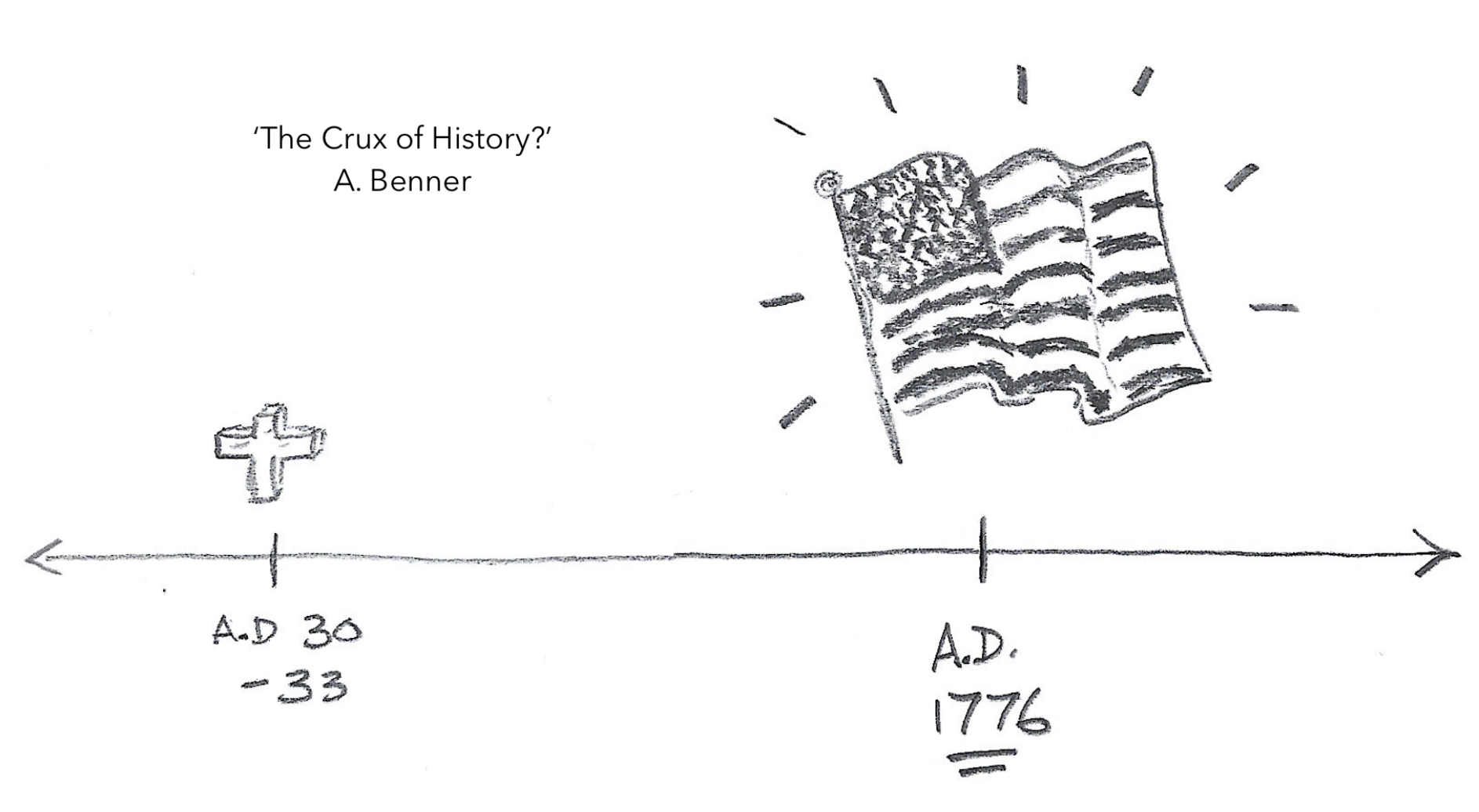
All four gospels make this same statement in their various ways. For the writers, this moment inaugurates the Kingdom of God. This is the real watershed of history. Not the foundation of any nation state. Not the raising of any democracy. Not the victory of any army. Not the signing of any constitution. So classic Christianity has always asserted. So we who call ourselves Christians ought to believe.
Now, Christian nationalists will likely argue something to the effect that the advent, death and resurrection of Jesus was history’s ‘spiritual’ turning point, while the advent and rise of the United States serves as its ‘earthly’ or ‘political’ turning point. Which suggests, first, that they think in terms of the split-level universe discussed in the previous post. In that universe, Jesus oversees afterlife admittance, leaving us to grasp for political power and influence here on earth, supposedly on God’s behalf. Second, it indicates that we’re indeed following two religions syncretized into one.
But the gospels leave us no room for this kind of bet-hedging. We either cast our lot with Jesus and insist that history finds its crucial juncture in him. Here, we find meaning in the way of the cross, from which his kingdom of love and peace is ruled. Or we see the coming of our nation as history’s key event and give our allegiance to a kingdom that advances in a very different manner to that of Jesus.
Contrary to what Christian nationalists believe, we have to choose.
Until next time…
May the God who has journeyed with humankind
Through all times that have passed
Journey with you this day and in the days to come.
- In actual fact, his name was Ousamequin; ‘Massasoit Sachem’ was a title meaning, ‘Great Sachem’
- Lest we think it was just school textbooks engaging in this kind of weak argumentation, consider Peter Marshall’s and David Manuel’s The Light and the Glory (1977), written for an adult audience. For example, here’s what they said about Columbus’ discovery: “If God did have a plan for America, He surely would have wanted His grand design for the New World to get off on the right foot… He had stocked it with an abundance of game and fertile soil, natural resources and beauty – all that a people would ever need – as a fitting abode for the followers of His Son” (p. 49). Yes, one could plainly see America was destined for us Christians, because it was full of deer and turkeys and arable land (once we took them from the Indians, of course).
- What about Vietnam, you ask? My textbooks had an answer for that too: hippies – godless, bleeding heart, liberal hippies, enslaved to psychedelic drugs and loud, Satanic, hard-rock musicians like Peter, Paul and Mary and Sweetwater, that cost America the blessing of God.
- Translation of the Latin ‘novus ordo seculorum’, which you can conveniently find on the Great Seal of the United States seen on the reverse side of your dollar bill.
- For a class on Johannine Literature, I was asked to read the entire Fourth Gospel in one sitting. Later, we would analyze the structure of the gospel and the literary techniques used by the author, among other things.
- Thus, the sign Pilate places on the cross, ‘Iesus Nazarenus, Rex Iudaeorum’ – ‘Jesus of King of the Jews’. The writer doesn’t mention it just for kicks. He’s a master of irony, instances of which appear over and over in the Fourth Gospel.
image sources
- The Crux of History?: Drawing by Author
Adam Lee Benner

A teacher and writer born and raised in New Jersey’s Philadelphia suburbs, Adam writes about his former life in American Christian nationalism and the Evangelical right – and (hopefully) better ways to be Christian. He lived for several years with his wife and best friend, Renée, as missionaries in Asia before relocating to her hometown of Melbourne, Australia with their two sons.
Leave a Reply